
The First Twelve Hours After You Point a Miner at a Pool
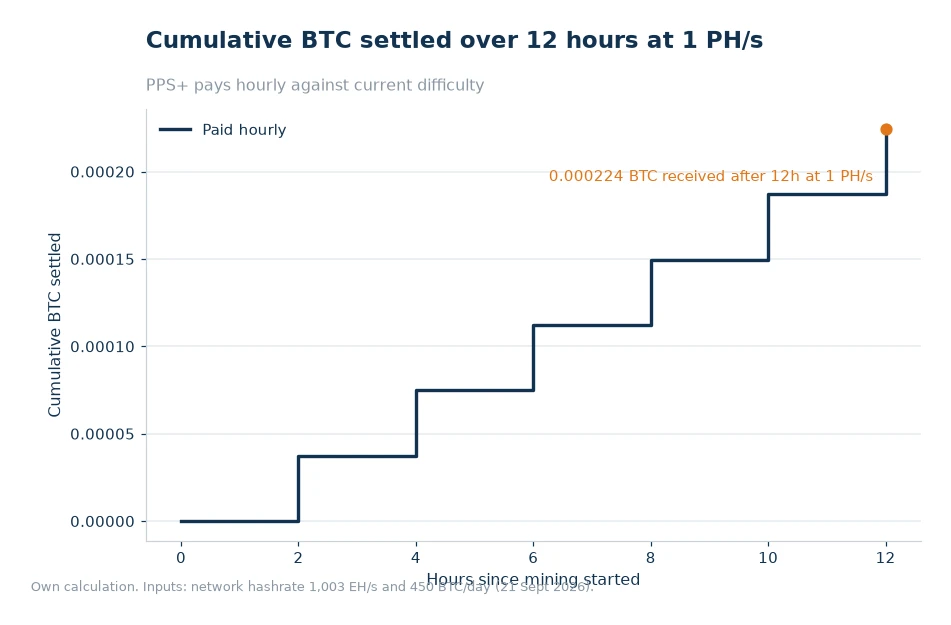
A single 1 PH/s worker settles about 0.0002243 BTC across its first 12 hours, roughly $19.00 at $84,692 per BTC. Those dozen hourly credits are the shakedown cruise: they confirm the worker name, the difficulty handling, and the payout path before real money accumulates. Watch them closely once, then relax.
Key takeaways
- Twelve hours at 1 PH/s should total 0.0002243 BTC, about $19.00 at $84,692.
- Each hourly credit averages 0.00001869 BTC; the first one or two may lag.
- Pool Hashrate on the Statistics page confirms your worker joined a healthy pool.
- Shortfalls under 5% usually trace to ramp-up and stale shares, not misconfiguration.
Hour zero: what should happen first
Point the machine at the pool stratum, double-check the worker name, and start it. Within minutes the dashboard should show the worker as active with hashrate climbing toward nominal. The pool-side effective rate lags the machine's own display by design — shares need time to accumulate statistically — so a 15-minute gap between local and pool figures is normal, not alarming.
The first hourly credit may also arrive light or late. Settlement windows cut at fixed times, so a worker that joins at twenty past the hour contributes a partial hour to its first credit. Judge the setup on hours three through twelve, not on hour one. Ten clean hourly steps in a row outweigh any ragged start.
Reading each two-hour block like a checklist
Break the half-day into six blocks of two hours, each worth about 0.00003738 BTC. After block one expect 0.00003738 BTC; after block two, 0.00007477 BTC; then 0.00011215, 0.00014954, 0.00018692, and finally 0.0002243 BTC at hour twelve. Tick them off as they land, and any block that misses by more than a tenth gets investigated the same evening.
| Block | BTC added | Running BTC | Running USD |
|---|---|---|---|
| Hours 1–2 | 0.00003738 | 0.00003738 | $3.17 |
| Hours 5–6 | 0.00003738 | 0.00011215 | $9.50 |
| Hours 9–10 | 0.00003738 | 0.00018692 | $15.83 |
| Hours 11–12 | 0.00003738 | 0.00022430 | $19.00 |
Four rows stand in for six to keep the table readable; the missing blocks follow the same 0.00003738 BTC cadence. If your export shows 0.00011215 BTC at hour six within a percent, the worker is dialed in. Consistent under-delivery across all six blocks points at clock, firmware, or network issues worth one focused evening of troubleshooting.
Confirm the pool side before blaming your side
New miners debug their own gear first and the pool last; experienced ones reverse that order. A glance at the ViaBTC Mining Statistics page takes twenty seconds and rules out an entire class of causes. Pool Hashrate steady near its recent norm, difficulty at 132.76 T, no incident flags — with those confirmed, whatever is wrong lives in your building.
This ordering saves real evenings. Chasing a "faulty" machine through firmware and cabling while the pool itself digests a difficulty transition burns hours and risks breaking something that worked. Check the collective numbers first, then walk to the shelf with confidence about where the fault boundary lies.
The three usual suspects in a ragged start
Unstable local power tops the list. Voltage sag under load reboots control boards without tripping breakers, producing the classic sawtooth of two good hours and one dead one. A clamped meter on the feed during the 12-hour window catches it directly; the fix is an electrician, not a settings page.
Second is network latency to the pool endpoint. Shares submitted late count as stale, which trims each hourly credit by a few percent without ever showing the worker offline. A wired connection and a nearby node region cure most of it. Third is simply heat: a unit throttling at high board temperatures reports full local hashrate while submitting fewer valid shares, a mismatch the two-hour checklist exposes by hour six at the latest.
Fees in miniature: what twelve hours cost you
The listed 4% on the PPS-settled block-reward component applies from the very first credit — there is no grace period and no minimum. On a $19.00 half-day the deduction is about $0.76, leaving the miner roughly $18.24 of block-reward value before any transaction-fee share. Small numbers, same rules as the largest farm.
Seeing the deduction early is actually useful. It converts the abstract fee schedule into a concrete twelve-hour memory: this is what 4% looks like, this often, forever. The fee schedule lists both PPS+ components and the PPLNS alternative, and after one shakedown window those rows read as lived experience rather than fine print.
Lock in the payout path while sums are small
Twelve hours in is the cheapest moment to verify withdrawals. Confirm the payout address, check the minimum threshold, and if the pool supports small test transfers, run one before the balance grows. Discovering a mistyped address at 0.0002243 BTC stings; discovering it at ten times that is a different conversation.
Zero-fee mining payouts mean the test costs nothing beyond the wait, and the mobile app mirrors the same payout screen for later checks from the couch. Set the threshold deliberately: too low and dust-sized transfers clutter records; too high and coins sit idle for weeks. One day's output, roughly 0.00044861 BTC at this scale, is a sensible middle ground for most home miners.
When twelve hours refuse to add up
Some shakedowns fail cleanly past hour twelve, with the total sitting 10% or more below 0.0002243 BTC and no single dead block to blame. Isolate variables in an order that costs nothing first. Switch the worker to a different pool endpoint region and watch two hours of credits; a latency-driven stale-share problem improves immediately. Roll firmware back one version if the shortfall began with an update; control-board updates occasionally alter share submission pacing in ways release notes never mention.
If the gap survives both tests, look at power quality and heat together. Borrow a logging meter and record voltage across a full hour — sags of even a few percent under load reset some control boards without tripping anything. Check exhaust temperatures board by board; a single hot board throttles while its neighbors report full speed, and the pool-side average hides the culprit inside an acceptable-looking total. When asking for help — community forums or the support guides on support.viabtc.com — bring the complete file: worker name, the twelve-hour export, local versus pool hashrate, and meter readings. Complete files get answers; vague complaints get sympathy.
Worked example
Build the 12-hour expectation from first principles.
- Network daily issuance: 144 × 3.125 = 450 BTC per day.
- Share of 1 PH/s: 1,000,000 ÷ 1,003,000,000 = 0.0000009969 of the network.
- Daily credit: 0.0000009969 × 450 = 0.00044861 BTC.
- Hourly step: 0.00044861 ÷ 24 = 0.00001869 BTC, or 1.869e-05 BTC.
- Two hours: 2 × 0.00001869 = 0.00003738 BTC ($3.17).
- Six hours: 6 × 0.00001869 = 0.00011215 BTC ($9.50).
- Twelve hours: 12 × 0.00001869 = 0.0002243 BTC, and 0.0002243 × 84,692 = $19.00.
Frequently asked questions
Is a light first credit a sign of trouble?
Almost never. Workers that join mid-hour earn a partial first credit; judge the setup on hours three through twelve instead.
How close to 0.0002243 BTC should twelve hours land?
Within about 5% for a healthy setup; ramp-up and stale shares explain small gaps, while larger ones point at power, heat, or connectivity.
When should I run a test withdrawal?
During the first day, while the balance is small; confirm the address and threshold before a full day of credits accumulates.
Pass the shakedown, then stop hovering
Twelve clean hours prove the worker name, the network path, the settlement math, and the payout address in one stroke. Log the 0.0002243 BTC result, note any anomaly and its fix, and demote the dashboard from obsession to routine. Get the mobile app for alerting, and let hours thirteen through ten thousand take care of themselves while the hourly credits stack quietly in the background.
Sources: pool payout documentation for hourly settlement and Statistics page contents[1]. Chain data read 21 Sept 2026: network hashrate 1,003 EH/s, difficulty 132.76 T, 3.125 BTC per block, 144 blocks a day, BTC $84,692. Published 24 Oct 2026; figures are arithmetic on those inputs.