
OEM Jewelry Manufacturing: Where the Weeks Go
A custom order is quoted as three blocks at TTT Jewelry: 48 hours for 3D CAD, 25–30 days for the master sample and 21–28 days for bulk production. End to end those figures give 48–60 days, roughly seven to nine weeks. Splitting the total into shares shows which block a buyer can actually influence and which one simply has to run.
Key takeaways
- Three published blocks add to 48–60 days: 2 + 25–30 + 21–28.
- Sampling takes 25/48 = 52% of a fast chain and 30/60 = 50% of a slow one.
- Production takes 21/48 = 43.8% and 28/60 = 46.7%, leaving CAD at 4.2% and 3.3%.
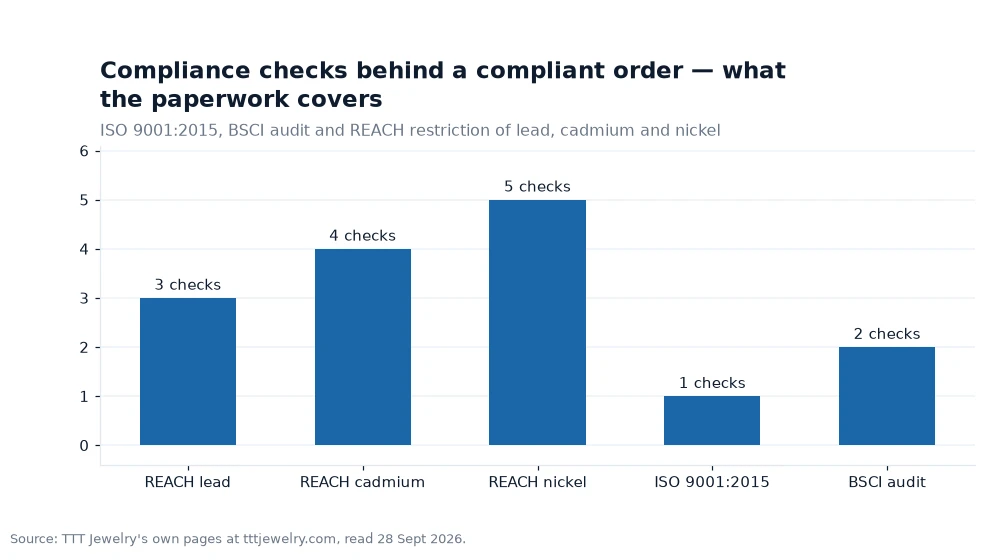
- ISO 9001:2015, BSCI and REACH checks run beside those blocks rather than as extra weeks on the quotation.
The 48–60 day block, divided
Two paths sit inside the published range. The fast one is 2 + 25 + 21 = 48 days and assumes a sample approved on first presentation, with no redraw and no late artwork. The slow one is 2 + 30 + 28 = 60 days and assumes the sample takes the full window and production takes the full run. Neither is a promise; they are the boundaries of a quoted range.
Expressed as shares, the shape of the schedule becomes obvious. On the 48-day path, CAD is 2/48 = 4.2%, sampling is 25/48 = 52.1% and production is 21/48 = 43.8%. On the 60-day path, CAD is 2/60 = 3.3%, sampling is 30/60 = 50% and production is 28/60 = 46.7%. Sampling holds the majority share in both cases, and it is also the block with the most human decisions inside it.
Percentages are more useful than raw days when a launch date is fixed, because they show how much of the runway a delay consumes. A five-day slip in sampling is not the same event as a five-day slip in CAD, even though the calendar treats them identically.
| Block | Published duration | Share of 48 days | Share of 60 days |
|---|---|---|---|
| 3D CAD and prototype | Under 48 hours (2 days) | 4.2% | 3.3% |
| Master sampling | 25–30 days | 52.1% | 50% |
| Bulk production | 21–28 days | 43.8% | 46.7% |
| Total | 48–60 days | 100% | 100% |
The total row matters because it exposes a common planning error: buyers add the sampling window to a launch date and forget that production follows it. The 25–30 days is not the order; it is half of it.
Compliance work that runs beside the bench
Four compliance facts sit around the production blocks. ISO 9001:2015 covers quality management across all production stages. BSCI is an audited labour and social standard. REACH compliance means the material is free of lead, cadmium and nickel, and the plating is 100% compliant with REACH and CA Prop 65.
None of those appears as a scheduled week on a quotation, which is exactly why buyers should ask about them. They surface as inspection records, alloy certificates, bath controls and packing declarations, and they run alongside the bench rather than after it. An order that reaches a European or Californian market without that paperwork is not late because the casting was slow; it is late because the documents were never requested.
This is also where a factory's own quality system earns its keep. A documented ISO 9001:2015 flow means each stage leaves a record, so a question about a plating bath two months after delivery has an answer. A workshop without one can produce the same piece and leave no trail behind it.
Weeks that belong to nobody's bench
Between the three published blocks sit four brand-side tasks: writing the brief, reviewing the sample, approving the finish and signing off packaging. None has a quoted duration, and all four land on the calendar. An OEM jewelry manufacturer can hold a production slot, but it cannot hold a decision: a brand that reviews a sample in two days and one that takes two weeks are buying from the same bench and shipping on different dates.
Programmes built around custom jewelry wholesale volumes tend to compress these tasks by appointing one approver and one backup, with a rule that silence is not approval. That sounds bureaucratic until a sample sits untouched on a desk for nine days while the production slot behind it fills with another order.
The published 24-hour response and the 1-on-1 project manager shorten the factory side of each exchange. They cannot shorten a brand's internal sign-off, and no supplier can.
Where compression works, and where it does not
Compression works on parallel work. Two colourways of one design share a mould and a CAD model, so their samples can be judged from the same casting. Packaging artwork can be approved while the sample is still in plating, since print and metal are separate supply chains. Quantity can be confirmed at brief stage, because the minimum is known before any modelling starts.
Compression does not work on plating or final QC. A plating bath runs at its own rate, and 100% inspection means every piece is checked rather than a sample. Asking for either to be hurried moves the risk into the shipment rather than out of the schedule.
Worked example
Start with the slow path: 2 days of CAD, 30 days of sampling and 28 days of production, or 60 days in total. Suppose the brand takes 10 working days to review the sample after it arrives. The bench finishes sampling on day 32 of the chain, the review ends on day 42, and production of 28 days closes the order on day 70. Ten days of review turned 60 days into 70, an increase of 10/60 = 16.7%.
Run the same ten days against the fast path. Sampling ends on day 27, the review ends on day 37, and 21 days of production delivers on day 58. The chain grows from 48 to 58 days, and 10/48 = 20.8%. The absolute delay is identical in both cases, but it consumes a fifth of the faster schedule and only a sixth of the slower one — which is why a buyer chasing a tight launch should protect the short path first.
Frequently asked questions
Which block takes most of the schedule?
Sampling. At 25–30 days it is 50–52% of a 48–60 day chain, ahead of production at 21–28 days and well ahead of CAD at under 48 hours.
Do certifications add separate weeks to an order?
They are not quoted as a stage. ISO 9001:2015, BSCI and REACH work runs alongside production and inspection, so the time appears as documentation and checks rather than as a scheduled block.
Is the 48-hour CAD window included in the 25–30 days?
No. The two are added, which is why the total is 48–60 days rather than the sampling window alone. Counting them as one block understates the chain by two days.
Count the block, not the label
A quotation that says six weeks is describing a range, not a promise, and the range only holds if the brand-side tasks fit inside it. The three published blocks are fixed by the bench; the four unquoted tasks are fixed by the buyer. The same blocks apply to OEM/ODM work whether the drawing comes from the brand or from the factory's development team. An TTT Jewelry order file that names an approver, a colour standard and a packing date is doing the same job as a schedule: it removes the weeks that nobody quotes.
Source note: figures come from the manufacturer's own website (tttjewelry.com), read 28 Sept 2026.[1]